The two most popular investment paths: buy stocks or buy property. Both have created millionaires. Both have their advantages.
But which is actually better for you? The answer depends on your starting capital, time, and risk tolerance.
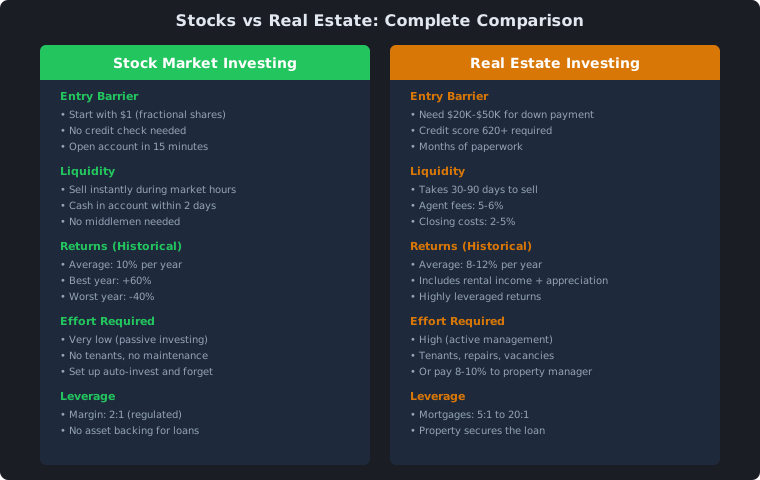
The Quick Comparison
| Factor | Stocks | Real Estate |
|---|
| Minimum to start | $1 | $20,000-$50,000 |
| Liquidity | Instant (2 days) | 30-90 days |
| Average return | 10%/year | 8-12%/year |
| Effort level | Passive | Active |
| Leverage | 2:1 | 5:1 to 20:1 |
| Tax advantages | Moderate | Significant |
| Income | Dividends | Rent |
Returns: Who Wins?
Stocks (Historical)
| Period | Average Annual Return |
|---|
| Last 10 years | 12.8% |
| Last 30 years | 10.2% |
| Last 50 years | 11.0% |
| S&P 500 (all-time) | 10.4% |
Real Estate (Historical)
| Period | Average Annual Return |
|---|
| Last 10 years | 8.5% (national average) |
| Last 30 years | 9.2% |
| Best markets (Austin, Phoenix) | 15-20% |
| With rental income | +3-5% additional |
Verdict: Stocks slightly outperform on average, but real estate with leverage can produce higher returns.
The Power of Leverage
This is where real estate shines:
| Investment | Down Payment | Leverage | Property Value | Equity |
|---|
| Stock | $50,000 | 1:1 | $50,000 | $50,000 |
| Rental | $50,000 | 5:1 | $250,000 | $50,000 |
| Rental | $50,000 | 10:1 | $500,000 | $50,000 |
Example: $50,000 down on a $250,000 property (5:1 leverage):
- Property appreciates 5% = $12,500 gain
- On $50,000 invested = 25% return
- Plus rental income: +$6,000/year (after expenses)
- Total first-year return: 37%
Stocks would need to return 37% in a year — which happens maybe once a decade.
Effort: The Hidden Cost
Stocks
- Open account: 15 minutes
- Buy index fund: 2 minutes
- Annual rebalance: 30 minutes
- Total annual time: ~1 hour
Real Estate
- Find property: 20-40 hours
- Due diligence: 10-20 hours
- Closing process: 20-30 hours
- Property management: 2-4 hours/week
- Maintenance: 5-10 hours/month
- Total annual time: 200-400 hours
Value of your time: If you value your time at $50/hour, that’s $10,000-$20,000 in “hidden costs” for real estate.
Tax Advantages
Real Estate Tax Benefits
| Deduction | Benefit |
|---|
| Mortgage interest | Deductible |
| Property taxes | Deductible (up to $10K) |
| Depreciation | $9,000/year deduction |
| 1031 exchange | Defer capital gains |
| Repairs | Deductible |
Stock Tax Benefits
| Benefit | Details |
|---|
| Long-term capital gains | 0-20% (vs 22-37% ordinary) |
| Tax-loss harvesting | Offset gains with losses |
| Roth IRA | Tax-free growth |
| 401(k) | Tax-deferred growth |
Risk Comparison
| Risk | Stocks | Real Estate |
|---|
| Market crash | Can lose 30-50% | Can lose 20-30% |
| Tenant risk | None | Bad tenants, vacancies |
| Liquidity risk | Low | High (hard to sell) |
| Concentration | Diversified | Single asset |
| Leverage risk | Low | Can lose everything |
| Management | None | Active management |
Which Should You Choose?
| Choose Stocks If… | Choose Real Estate If… |
|---|
| Starting with <$10K | Have $20K+ for down payment |
| Want passive investing | Enjoy hands-on work |
| Need liquidity | Don’t need quick access |
| Like diversification | Want concentrated bet |
| Prefer simplicity | Want tax advantages |
| Young and building wealth | Have time to manage property |
The Hybrid Approach: REITs
If you want real estate exposure without the hassle:
| REIT ETF | What It Does | Yield |
|---|
| VNQ | Diversified U.S. REITs | 3.8% |
| O | Monthly dividend REIT | 4.5% |
| VNQI | International REITs | 4.2% |
Benefits: Real estate returns + stock-like liquidity + no tenants
The Math: $100,000 Invested for 10 Years
| Scenario | Starting | Year 10 | Total Return |
|---|
| S&P 500 ETF | $100,000 | $259,374 | +159% |
| Rental property (5:1 leverage) | $100,000 | $320,000 | +220% |
| Rental property (after expenses) | $100,000 | $260,000 | +160% |
| REIT ETF | $100,000 | $235,000 | +135% |
Key insight: Real estate with leverage wins, but only if you manage it well. After expenses, stocks and real estate perform similarly.
Summary
| Key Point | Takeaway |
|---|
| Stocks | Easier, more liquid, slightly better average returns |
| Real estate | Higher potential with leverage, but more work |
| Best for beginners | Stocks (low barrier, passive) |
| Best for wealth building | Real estate (leverage + tax benefits) |
| Best of both | REITs for real estate exposure without hassle |
| The real answer | Both — diversify across asset classes |
This content is for educational purposes only. Not financial advice. Do your own research before investing.