Gold has been money for 5,000 years. Bitcoin has existed for 17. One is ancient, one is revolutionary.
Both are seen as stores of value. Both are alternatives to fiat currency. But which is actually better for your portfolio in 2026?
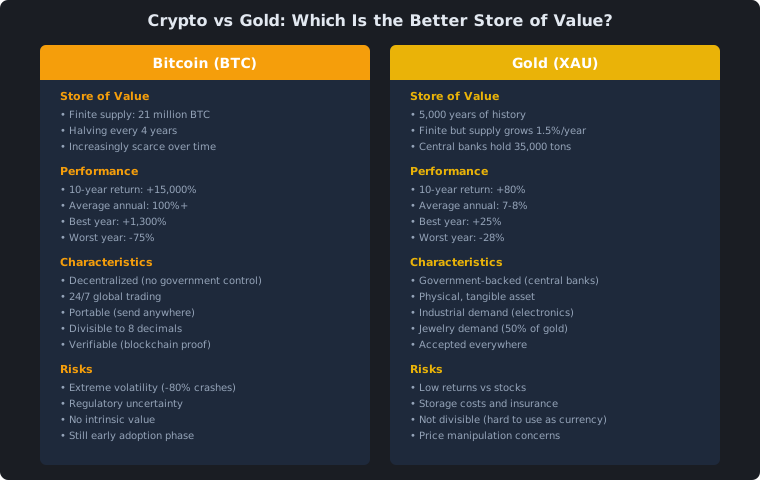
The Quick Comparison
| Factor | Bitcoin | Gold |
|---|
| Market cap | $2.1 trillion | $14.5 trillion |
| 10-year return | +15,000% | +80% |
| Average volatility | 60-80% | 15-20% |
| Supply | 21 million (finite) | Growing 1.5%/year |
| Divisibility | 8 decimal places | Difficult to divide |
| Portability | Send anywhere instantly | Heavy, hard to transport |
| Storage | Digital (free) | Physical (costs money) |
| History | 17 years | 5,000 years |
Store of Value: The Debate
Bitcoin’s Case
| Argument | Evidence |
|---|
| Scarcity | 21 million max supply, no more |
| Halving | New supply cuts in half every 4 years |
| Adoption | Growing institutional ownership |
| Decentralization | No government can print more |
| Network effect | 420M+ wallets worldwide |
Gold’s Case
| Argument | Evidence |
|---|
| Track record | 5,000 years as money |
| Central bank backing | 35,000 tons held globally |
| Physical | Tangible, can’t be hacked |
| Industrial use | Electronics, jewelry, dentistry |
| No technology risk | Won’t become obsolete |
Historical Returns
| Period | Bitcoin | Gold | S&P 500 |
|---|
| Last 1 year | +120% | +15% | +18% |
| Last 5 years | +1,500% | +60% | +85% |
| Last 10 years | +15,000% | +80% | +180% |
Risk-Adjusted Returns
| Metric | Bitcoin | Gold |
|---|
| Maximum drawdown | -83% | -45% |
| Sharpe ratio (5-year) | 1.2 | 0.6 |
| Correlation to stocks | 0.3 | 0.05 |
Inflation Hedge: Which Works Better?
| Inflation Period | Bitcoin | Gold |
|---|
| 2021-2022 (CPI 9%) | +55% | +3% |
| 2020-2021 (CPI 5%) | +600% | +25% |
| Historical (10%+ inflation) | N/A | +15% average |
Verdict: Bitcoin has outperformed gold during recent inflationary periods, but gold has a longer track record.
The Institutional Shift
| Year | Institutional Bitcoin Holdings | Institutional Gold Holdings |
|---|
| 2020 | $10B | $3.5T |
| 2022 | $50B | $3.8T |
| 2024 | $200B | $4.2T |
| 2026 | $500B+ | $4.5T |
Key development: Spot Bitcoin ETFs approved in 2024. BlackRock, Fidelity, and others now offer Bitcoin exposure to institutional investors.
Practical Comparison
| Use Case | Bitcoin Wins | Gold Wins |
|---|
| Long-term store of value | ✓ (newer, higher growth) | ✓ (5,000 years proven) |
| Inflation hedge | ✓ (outperformed recently) | ✓ (longer track record) |
| Portfolio diversification | ✓ (low correlation) | ✓ (negative correlation) |
| Emergency money | ✓ (portable, divisible) | ✓ (no tech needed) |
| Speculative growth | ✓ (higher potential) | |
| Stability | | ✓ (lower volatility) |
| No counterparty risk | ✓ (self-custody) | ✓ (physical possession) |
How Much to Allocate?
Conservative (5% crypto, 5% gold)
| Asset | Allocation | Purpose |
|---|
| Stocks | 70% | Growth |
| Bonds | 20% | Stability |
| Gold | 5% | Hedge |
| Bitcoin | 5% | Hedge |
Moderate (3% crypto, 7% gold)
| Asset | Allocation | Purpose |
|---|
| Stocks | 65% | Growth |
| Bonds | 25% | Stability |
| Gold | 7% | Hedge |
| Bitcoin | 3% | Growth hedge |
Aggressive (10% crypto, 2% gold)
| Asset | Allocation | Purpose |
|---|
| Stocks | 60% | Growth |
| Bonds | 28% | Stability |
| Gold | 2% | Stability |
| Bitcoin | 10% | Growth hedge |
The Tax Advantage
| Aspect | Bitcoin | Gold |
|---|
| Long-term capital gains | 0-20% | 28% (collectibles rate) |
| Tax-loss harvesting | Yes | Yes |
| In-kind transfer | Yes | No |
| Self-custody | Yes | Yes |
Bitcoin wins on taxes: The 28% collectibles rate on gold means higher taxes on gains. Bitcoin is taxed at the lower 20% long-term rate.
The Future Outlook
| Factor | Bitcoin | Gold |
|---|
| Adoption curve | Early (4% of world) | Mature (30%+ of world) |
| Technology risk | Moderate | None |
| Government regulation | Uncertain | Established |
| Supply trajectory | Fixed forever | Growing slowly |
| Digital transformation | Native | Competing |
Summary
| Key Point | Takeaway |
|---|
| Bitcoin | Higher returns, higher risk, more upside |
| Gold | Lower returns, lower risk, proven track record |
| Best as hedge | Both — they serve different roles |
| Tax advantage | Bitcoin (lower capital gains rate) |
| Allocation | 3-10% Bitcoin, 2-7% gold depending on risk |
| The smart move | Own both — they’re not mutually exclusive |
This content is for educational purposes only. Not financial advice. Do your own research before investing.