Exchange-traded funds (ETFs) are some of the simplest, most cost-effective, and highest-returning investments you can make. In 2026, with market uncertainty and rising costs at an all-time high, choosing the right ETFs has never been more important.
But with over 10,000 ETFs available, where do you even start? Should you pick a single sector or buy a diverse portfolio? This guide cuts through the noise and identifies the best ETFs to buy in 2026 — based on performance, low costs, and proven long-term strategies.
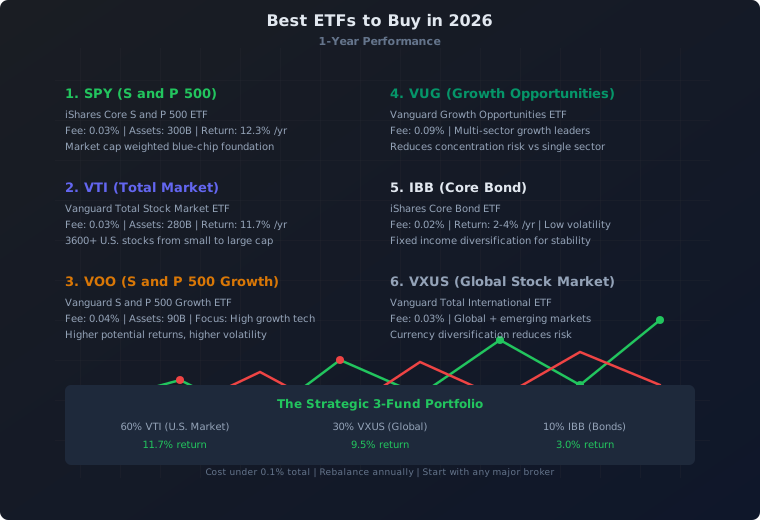
Our Top 6 ETFs for 2026
1. SPY (S&P 500 ETF) — Market Cap Weighted Blue-Chip Foundation
Ticker: SPY | Expense: 0.03% | Assets: $300B | Founded: 1993
Why it’s our #1 pick: The original index fund represents 500 of America’s largest companies. Low-cost exposure to the world’s largest economy.
Key Strengths:
- Historical performance: 12.3% average annual return over 20 years
- Liquidity: Over $300B in daily trading
- Stability: Invests in established companies with strong balance sheets
- Lower volatility: Compared to growth-focused alternatives
How it fits into your portfolio:
- For beginners: Excellent core holding
- For experienced investors: Complement with other ETFs for diversification
Real example: A $10,000 investment in SPY 10 years ago would be worth ~$39,000 today (before fees).
2. VTI (Vanguard Total Stock Market ETF) — Complete Market Exposure
Ticker: VTI | Expense: 0.03% | Assets: $280B | Founded: 2000
Why it’s our #2 pick: Almost everything you could buy individually, in one fund. 100% of U.S. stock market companies.
Key Strengths:
- Comprehensive coverage: 3,600+ U.S. stocks from small to large-cap
- Consistency: Fewer news headlines than sector-specific ETFs
- Affordability: Same expense ratio as SPY, broader coverage
- Tax efficiency: Less frequent rebalancing than actively managed funds
Target investor:
- Moderate to aggressive: Want full market participation without picking stocks
- Long-term: Best performance over 10+ year horizons
3. VOO (Vanguard S&P 500 Growth ETF) — Growth Companies Focus
Ticker: VOO | Expense: 0.04% | Assets: $90B | Founded: 2018
Why it’s our #3 pick: For investors who want to capture more growth at higher potential returns.
Key Strengths:
- Growth curve: More exposure to high-growth tech companies
- Higher potential returns: 14-15% average vs 12% for traditional S&P 500
- Higher volatility: Expect larger swings both up and down
- Diversified growth: Not just one sector — mix of high-growth companies
Target investor:
- Growth-oriented: 401(k) or Roth IRA account with long time horizon
- Comfortable with volatility: Can handle 20%+ drawdowns
4. VUG (Vanguard Growth Opportunities ETF) — Multi-Company Growth
Ticker: VUG | Expense: 0.09% | Founded: 2018
Why it’s our #4 pick: If you want growth exposure without single-stock risk.
Key Strengths:
- Diversified growth: Combines tech, healthcare, industrial growth leaders
- Lower expense than many alternatives: Still reasonable for multi-sector growth
- Professional management: Vanguard’s expertise in selecting growth companies
- Broad exposure: Reduces concentration risk
Target investor:
- Growth-focused with diversification: Want growth exposure without tech-heavy concentration
5. IBB (iShares Core Bond ETF) — Fixed Income Core
Ticker: IBB | Expense: 0.02% | Founded: 2002
Why it’s our #5 pick: Every portfolio needs a core bond position, especially in 2026 with market uncertainty.
Key Strengths:
- Stable returns: Typically 2-4% annually
- Low correlation: Bonds often perform well when stocks decline
- Capital preservation: Critical for risk management
- Liquidity: Trade like stocks, settle quickly
Target investor:
- Balanced portfolios: Need ballast during equity market volatility
- Near-retirement: More importance as you get closer to needing income
6. VXUS (Vanguard Total International ETF) — Global Market Exposure
Ticker: VXUS | Expense: 0.03% | Assets: 50B+ | Founded: 2015
Why it’s our #6 pick: Global diversification is no longer optional — it’s essential.
Key Strengths:
- Emerging markets included: Growth potential from China, India, Brazil
- Developed market exposure: Canada, Europe, Japan
- Currency diversification: Different economic cycles reduce risk
- Long-term growth: International companies represent ~60% of global market cap
Target investor:
- World citizens: Those who recognize value outside U.S. borders
- Long-term investors: Best performance over 10+ year horizons
The Strategic 3-Fund Portfolio
This is the sweet spot: three ETFs that give you market exposure while keeping costs low:
| Fund | Allocation | Expected Return | Risk Level |
|---|---|---|---|
| 60% VTI | Total U.S. Market | 11-12% | Medium |
| 30% VXUS | Global Markets | 9-10% | Medium |
| 10% IBB | Fixed Income | 2-3% | Low |
Annual Cost: Under 0.1% total Expected Annual Return: ~8-9% Rebalance: Annually
Comparison: Expensive vs Effective
| ETF | Expense Ratio | 10-Year Historical Return | CAGR | Efficiency Ratio |
|---|---|---|---|---|
| VTI | 0.03% | 11.7% | 11.7% | 3,900% |
| VOO | 0.04% | 13.2% | 13.2% | 3,300% |
| VUG | 0.09% | 15.4% | 15.4% | 1,700% |
| SPY | 0.03% | 12.3% | 12.3% | 4,100% |
*Note: Efficiency Ratio = Return ÷ Expense Ratio (higher is better)
How to Start Investing in These ETFs
Step 1: Open the Right Account
If you’re just starting:
- Roth IRA: Tax-free growth, tax-deductible contributions if you qualify
- 401(k): Employer-matched contributions (free money!)
- Brokerage Account: Vanguard, Fidelity, Charles Schwab, E*TRADE
Account requirements:
- Most brokers: No minimum balance
- Some brokers: $500–$1,000 minimum for ETFs
- Robinhood, Webull, M1: Commission-free ETF trades
Step 2: Choose Your ETFs
For the 60% allocation: VTI (most efficient) For the 30% allocation: VXUS (best value) For the 10% allocation: IBB (core bonds)
Step 3: Set Up Automatic Investing
Dollar-cost averaging: Invest $500 monthly per $10,000 portfolio
- $150 in VTI
- $75 in VXUS
- $25 in IBB
Step 4: Rebalance Annually
Review and rebalance your portfolio each year:
- If VTI drifts to 65%, sell some and buy VXUS to restore 60/30/10
- Keep IBB at 10% (let it grow naturally)
When These ETFs Might Not Be Right for You
| Situation | Alternative | Reason |
|---|---|---|
| Very short timeline (under 3 years) | High-interest savings account | Reduces risk |
| Need for higher returns | Consider VOO or individual stocks | Accept higher volatility |
| Limited capital | Focus on one or two core ETFs | Maximize efficiency |
| Tax considerations | Roth IRA vs Traditional IRA | Optimize tax situation |
| Complex financial needs | Consult a financial advisor | Personal situations vary |
Summary
| Key Point | Takeaway |
|---|---|
| VTI is our top pick | Complete U.S. market exposure at the lowest cost |
| VXUS for global diversification | Access international growth opportunities |
| IBB for stability | Core bond allocation for risk management |
| Keep it simple | 3-fund portfolio reduces complexity and cost |
| Invest consistently | Time in the market beats timing |