Staking crypto earns rewards — and those rewards are taxable. The IRS, HMRC, and CRA all treat staking income as taxable income.
Here’s how to properly report your staking rewards.
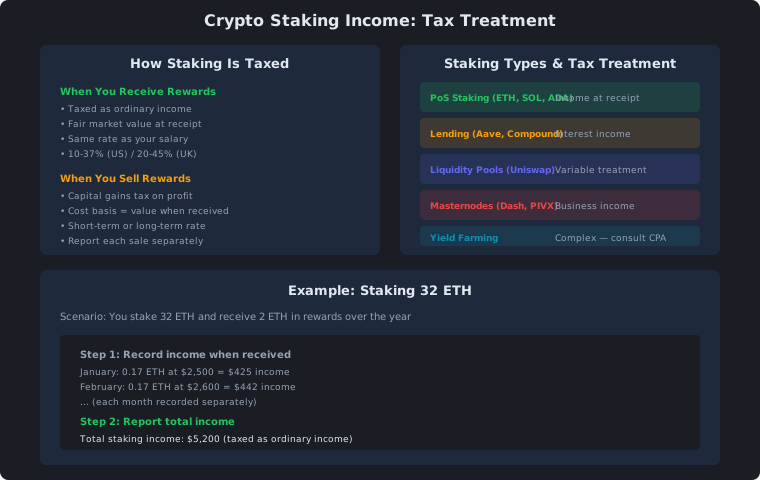
How Staking Is Taxed
Step 1: Income When Received
Every time you receive staking rewards, it’s taxed as ordinary income at fair market value.
| Country | Tax Rate | When Taxed |
|---|
| US | 10-37% | When received |
| UK | 20-45% | When received |
| Canada | 20-53% | When received |
Step 2: Capital Gains When Sold
When you sell the staked crypto, you pay capital gains tax on the difference between sale price and value when received.
| Example | Amount |
|---|
| Received 1 ETH staking reward at $2,500 | $2,500 income |
| Sold ETH later at $3,000 | $500 capital gain |
| Total tax | Income tax on $2,500 + capital gains on $500 |
Staking Types and Tax Treatment
| Staking Type | Tax Treatment | Examples |
|---|
| Proof-of-Stake | Income at receipt | ETH, SOL, ADA |
| Delegation | Income at receipt | DOT, ATOM, XTZ |
| Lending | Interest income | Aave, Compound |
| Liquidity Pools | Variable | Uniswap, Curve |
| Masternodes | Business income | Dash, PIVX |
| Yield Farming | Complex | Various DeFi |
Real-World Example: Staking 32 ETH
Let’s say you stake 32 ETH and receive 2 ETH in rewards over the year:
| Month | Rewards (ETH) | ETH Price | Income |
|---|
| Jan | 0.17 | $2,500 | $425 |
| Feb | 0.17 | $2,600 | $442 |
| Mar | 0.17 | $2,700 | $459 |
| Apr | 0.17 | $2,800 | $476 |
| May | 0.17 | $2,900 | $493 |
| Jun | 0.17 | $3,000 | $510 |
| Jul | 0.17 | $2,900 | $493 |
| Aug | 0.17 | $3,100 | $527 |
| Sep | 0.16 | $3,200 | $512 |
| Oct | 0.16 | $3,300 | $528 |
| Nov | 0.16 | $3,400 | $544 |
| Dec | 0.16 | $3,500 | $560 |
| Total | 2.0 | | $5,969 |
US tax at 24% marginal rate: $1,432
Reporting Staking Taxes
US (IRS)
| Form | Purpose |
|---|
| Form 1040 | Report staking income as “Other Income” |
| Schedule 1 | Line 8z for staking rewards |
| Form 8949 | When you sell staked crypto |
| Schedule D | Capital gains summary |
UK (HMRC)
| Form | Purpose |
|---|
| Self Assessment | Report staking as income |
| SA100 | Main tax return |
| SA108 | Capital gains supplement |
| Trading records | Keep detailed logs |
Canada (CRA)
| Form | Purpose |
|---|
| T1 Return | Report staking income |
| Line 12100 | Interest and other investment income |
| Schedule 3 | Capital gains when selling |
| T5008 | Securities transactions |
Common Mistakes
| Mistake | Consequence |
|---|
| Not reporting staking income | IRS penalties + back taxes |
| Reporting only when selling | Underreporting income |
| Not tracking reward dates | Can’t calculate cost basis |
| Ignoring small amounts | All income is taxable |
| Using wrong cost basis | Overpaying or underpaying taxes |
How to Track Staking Taxes
| Method | Best For |
|---|
| Tax software | Most users (auto-imports) |
| Exchange reports | Simple staking only |
| CSV export | Manual tracking |
| Tax professional | Complex DeFi staking |
| Tool | Staking Support | Price |
|---|
| Koinly | Excellent | $49-279 |
| CoinTracker | Good | $59-599 |
| TaxBit | Good | Free |
| ZenLedger | Good | $49-999 |
Summary
| Key Point | Takeaway |
|---|
| Staking = income | Taxed when received, not when sold |
| Two tax events | Income tax + capital gains tax |
| Record everything | Date, amount, price for each reward |
| Report all amounts | Even small rewards are taxable |
| Use tax software | Auto-imports and calculates |
This content is for educational purposes only. Not financial advice. Do your own research before investing.