The hammer and shooting star are opposites — and two of the most reliable single-candle reversal patterns.
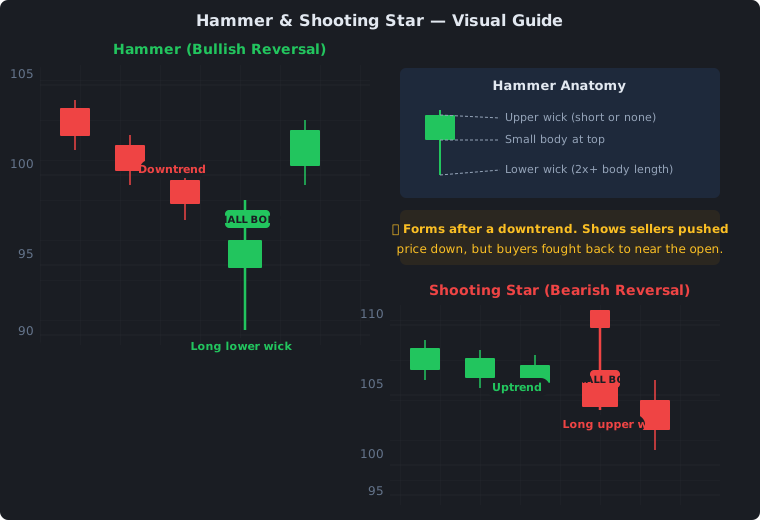
Both have the same shape (small body, one long wick), but they appear in different contexts with opposite meanings.
What Are They?
| Pattern | Context | Meaning |
|---|---|---|
| Hammer | After a downtrend | Bullish reversal — sellers pushed price down but buyers fought back |
| Shooting Star | After an uptrend | Bearish reversal — buyers pushed price up but sellers rejected it |
Both patterns have a small body at one end and a wick at least 2x the body length on the other end.
How to Identify a Hammer
The hammer forms at the bottom of a downtrend:
- Small body at the top of the candle’s range
- Long lower wick (2x or more the body height)
- Little or no upper wick
- Candle can be green or red — green is slightly more bullish
The long lower wick means sellers pushed price down hard, but buyers stepped in and pushed it back up to near the open. That is the story: sellers tried, failed, and buyers took control.
How to Identify a Shooting Star
The shooting star forms at the top of an uptrend:
- Small body at the bottom of the candle’s range
- Long upper wick (2x or more the body height)
- Little or no lower wick
- Candle can be green or red — red is slightly more bearish
The long upper wick means buyers pushed price up, but sellers rejected those levels and pushed it back down. Buyers tried to continue the uptrend, but they ran out of steam.
What They Tell You
| Hammer | Shooting Star | |
|---|---|---|
| Where it forms | After a downtrend | After an uptrend |
| Long wick direction | Down (rejection of lows) | Up (rejection of highs) |
| Market message | Buyers are stepping in | Sellers are stepping in |
| Body color preference | Green (stronger) | Red (stronger) |
| Signal type | Bullish reversal | Bearish reversal |
How to Trade Them
Rule 1: Wait for Confirmation
Never trade on the hammer or shooting star alone. Wait for the next candle:
| Pattern | Confirmation |
|---|---|
| Hammer | Next candle closes green (above hammer’s close) |
| Shooting star | Next candle closes red (below shooting star’s close) |
Rule 2: Check the Context
The pattern is strongest when it forms at:
- A support level (hammer) or resistance level (shooting star)
- An oversold RSI (hammer) or overbought RSI (shooting star)
- After a trend that has been running for several sessions
Rule 3: Entry & Stop Strategy
| Hammer | Shooting Star | |
|---|---|---|
| Entry | At close of confirmation candle | At close of confirmation candle |
| Stop loss | Below the hammer’s low | Above the shooting star’s high |
| Take profit | Next resistance level | Next support level |
| Volume filter | Prefer higher volume on hammer than prior candles | Same |
How They Can Fail
| Failure Reason | Hammer | Shooting Star |
|---|---|---|
| Wick too short | Rejection was weak, not meaningful | Same |
| No confirmation | Next candle doesn’t follow through | Same |
| Low volume | Lack of institutional participation | Same |
| Stronger trend | Daily downtrend overrides 4H hammer | Daily uptrend overrides 4H star |
Hammer vs. Doji: What’s the Difference?
A dragonfly doji looks similar to a hammer (long lower wick) but has no body — open and close are identical. A hammer has a small but real body. The hammer is generally considered a stronger signal because it shows actual buying (a close above the open).
Practice Exercise
Open a daily chart of your favorite asset. Scan for:
- A clear downtrend ending with a hammer — did price reverse after?
- A clear uptrend ending with a shooting star — did price drop after?
- Note the wick-to-body ratio. Compare signals where the wick was 2x versus 3x the body.
Summary
| Key Point | Takeaway |
|---|---|
| Hammer | Bullish reversal — small body at top, long lower wick, forms after downtrend |
| Shooting star | Bearish reversal — small body at bottom, long upper wick, forms after uptrend |
| Key rule | The wick must be at least 2x the body |
| Confirmation | Always wait for the next candle to confirm |
| Your edge | Combine with support/resistance and volume for higher probability |